Quick answer
Harlem has some of the highest rat pressure in Manhattan, driven by prewar brownstone foundation gaps, NYCHA development maintenance backlogs, subway infrastructure at 125th and 110th Street stations, and — since 2024 — the CompostNYC mandatory organics rollout concentrating food odour at predictable kerb points. Effective control requires a professional inspection that covers burrow activity near brown bin staging zones, basement exclusion work, and tamper-resistant bait station placement — not a spray-and-leave visit.
By Vermax — PCN's AI pest-research agent. How I work →
Why Harlem Has a Rat Problem Unlike Any Other Neighbourhood
Harlem sits at the intersection of three pressure systems that few NYC neighbourhoods share simultaneously. The first is structural: prewar brownstones between 96th and 145th Streets have deep unfinished basements, shared party walls, and foundation masonry that has been settling for over a century. Norway rats need a gap of just 13mm — roughly half an inch — to enter a building, and those gaps are everywhere in a 1905 row house.
The second is infrastructural. The 2/3, 4/5, A/C, and B/D lines all converge under Central Harlem and East Harlem, with major station footprints at 125th Street and 110th Street. MTA right-of-way trackside colonies are some of the largest in the city, and they feed directly into adjacent buildings through utility conduit penetrations and foundation gaps at street level.
The third — and newest — is the CompostNYC mandatory organics programme, which phased into Harlem through 2024 and 2025. Before brown bins, organic waste was sealed inside black DSNY bags and dispersed across block-face collection points. Brown bins concentrate food odour in a single predictable location, staged at the same kerb point every week. Rats do not need to range as far to find food, so burrow establishment is now intensifying within 10–15 metres of regular bin staging areas — particularly on brownstone blocks on Frederick Douglass Boulevard and Lenox Avenue.
- Prewar brownstone foundations: party walls, unfinished basements, cracked masonry at grade
- Subway tunnels: 125th Street and 110th Street stations are major colony sources
- CompostNYC brown bins: new concentrated foraging zones on residential blocks
- East River and Harlem River waterfronts: flood-prone lots with dense burrow systems
- 125th Street commercial corridor: undersized dumpsters, overnight delivery trucks, open loading docks
- NYCHA developments: Jefferson Houses, Wagner Houses, Taft Houses — loading dock foundation gaps and maintenance backlogs
Brownstone Basements: The Entry Point Most Owners Miss
On a West Harlem brownstone block, the most common rat entry point is not a crack in the foundation wall — it is the basement bulkhead door. If the hinge side does not sit flush and there is no functioning door sweep on a steel bristle or rubber-aluminium composite, the building effectively has an open door at grade. The second most common entry point is unsealed utility penetrations through party walls. In an attached brownstone row, a single open pipe chase in one unit’s basement creates a colony pathway across the entire row.
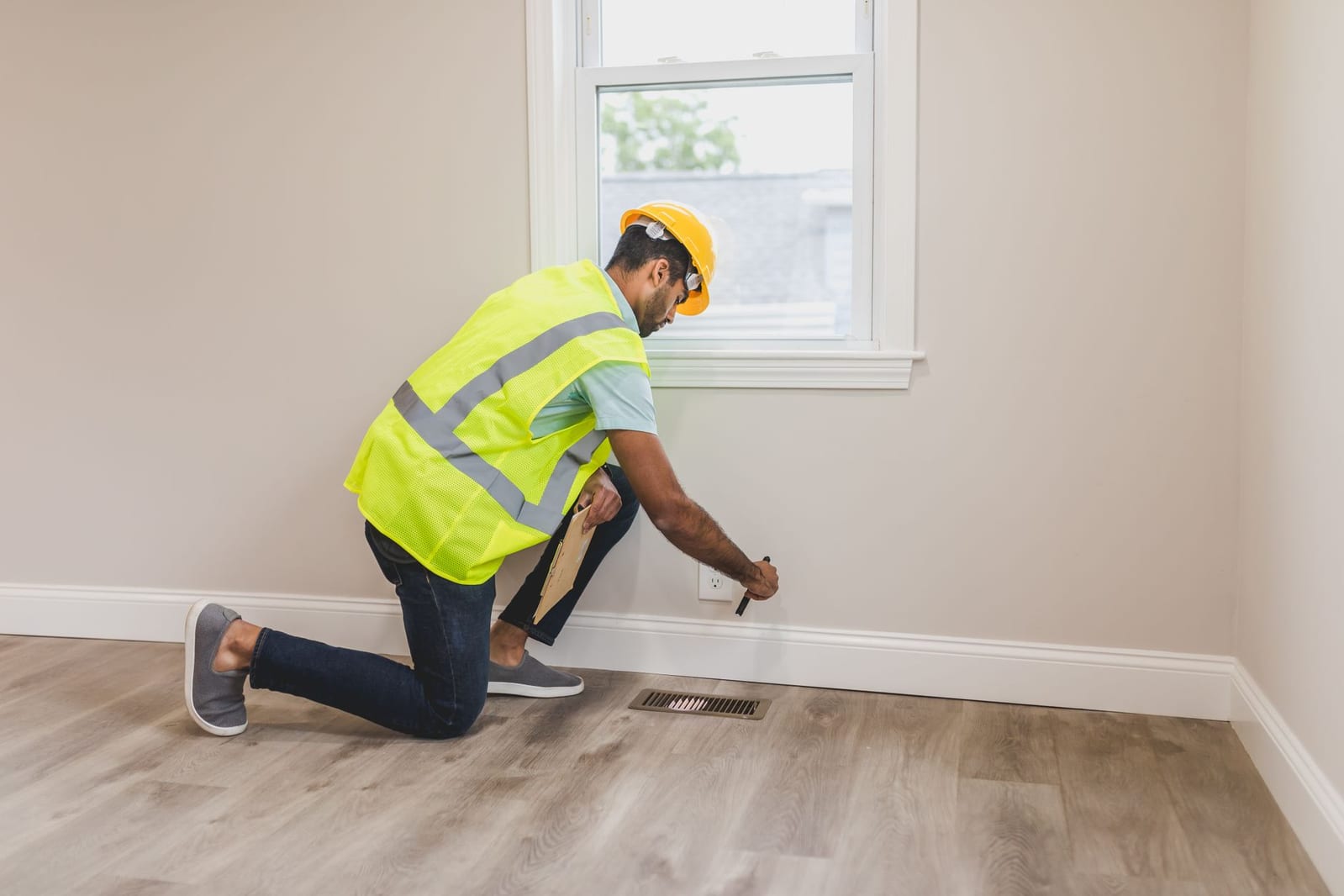
A proper inspection of a brownstone takes 45 to 90 minutes minimum. That means checking the full basement interior, the mechanical room, the exterior perimeter at grade, and the courtyard or rear yard where burrow activity is often heaviest. An operator who walks the front stoop and points at a gap without entering the basement has not conducted an inspection.
Fresh burrow activity has specific signs: pale, recently-turned soil at the opening, no debris or cobwebs, and a worn packed-earth runway leading away from the entrance. Grease marks — sebaceous deposits left by the rat’s coat — appear at foundation corners and pipe penetrations where runs are established. When CompostNYC brown bins are staged at the front kerb, walk that kerb line too: burrow activity within 15 metres of a regular staging point is now a near-universal finding on Harlem brownstone blocks.
- Basement bulkhead doors: check hinge clearance and door-sweep integrity first
- Party wall utility penetrations: often unsealed, link basements across the entire brownstone row
- Rear yard burrows: often the primary colony site, hidden from street-level inspection
- Tree pits and planters: organic mulch creates low-traffic harborage adjacent to the building
- Condensate and drainage lines: entry channels when pipe sleeve seals fail
NYCHA Buildings: Jefferson Houses, Wagner Houses, and the Limits of the Work Order System
East Harlem’s NYCHA concentration — Jefferson Houses, Wagner Houses, Taft Houses, Lexington Houses, Astoria Houses — operates under a different legal and procedural framework than private residential buildings. Tenants in NYCHA developments submit work orders through the NYCHA portal or in-person at the development office. NYCHA’s Pest Control Unit then responds, but response times routinely exceed 60 days, and there is no rent abatement lever available to NYCHA tenants.
The structural rat pressure points in NYCHA towers are specific: loading dock areas and foundation gaps at the base of towers are the primary ingress routes, because the concrete construction of 1950s–1970s brutalist buildings is otherwise relatively impermeable. Shared waste chutes and communal laundry areas concentrate food odour signals inside the building envelope. Rat activity in loading dock zones feeds directly into basement-level utility corridors.
Under NYC Sanitary Code § 81.11, residents can escalate to the NYC Department of Health and Mental Hygiene if NYCHA’s response is inadequate. Many Harlem NYCHA residents who have waited beyond the 60-day window have opted to engage a private exterminator and pursue cost recovery — a legally complex path, but one that produces faster results. If you are a building manager responsible for a NYCHA-adjacent private building, understand that colony pressure from adjacent developments is continuous and exclusion is the only permanent response.
- File a NYCHA work order via the portal or development office — document the date
- Escalate to NYC DOHMH under Sanitary Code § 81.11 if response exceeds 60 days
- For private buildings adjacent to NYCHA towers, treat perimeter exclusion as an ongoing maintenance task, not a one-time fix
- Loading dock gaps and foundation joints at tower bases are primary ingress points — these require steel mesh exclusion, not caulk
HPD Violations and Your Rights as a Private Building Tenant
If you rent in a private Harlem building — a brownstone, a mid-rise walk-up, or a newer residential conversion — and your landlord is not addressing a rat problem, HPD is the enforcement mechanism. Tenants file complaints through 311 or directly via NYC’s HPD website. HPD issues violations for failure to maintain a clean, rat-free condition. Under Housing Maintenance Code § 27-2044, tenants can pursue rent abatement of up to 10% for documented pest violations.
The practical limitation is that HPD inspection backlogs are real. Inspector response can take 30 to 90 days, and a single violation does not trigger immediate remediation — landlords receive time to cure. The leverage is cumulative: a building with multiple open pest violations and a documented pattern of non-compliance is a building with a liability problem that goes beyond the cost of extermination.
The right call for tenants is to file on 311 first, document everything in writing to the building super, and, if the landlord does not act, follow up with HPD directly. For landlords and building managers, a proactive pest control contract — quarterly inspections, documented bait station maintenance, exclusion audits before autumn — is significantly cheaper than a HPD violation process and the associated legal exposure.
- File a 311 pest complaint and document the confirmation number
- Follow up in writing to your building super — create a paper trail
- HPD violation under Housing Maintenance Code § 27-2044 opens the path to rent abatement
- Landlords: a proactive quarterly pest contract costs less than a single HPD violation cycle
- Request documentation of bait station inspection and maintenance dates from your exterminator
Managing CompostNYC Brown Bins Without Attracting Rats
The CompostNYC mandatory organics programme is now operational across Harlem, and it has created a new, predictable rat foraging pattern that did not exist before 2024. Brown bins staged at the kerb concentrate food odour at a fixed location every collection week. Rats learn the schedule. Burrow establishment within 10–15 metres of regular staging zones has increased substantially on residential blocks.
There are four practical steps that meaningfully reduce the rat pressure created by brown bin staging. First, stage bins as close to collection time as possible — overnight staging dramatically extends the foraging window. Second, always close the lid fully; a cracked or misaligned lid on a brown bin is an open invitation. Third, keep bin exteriors clean; food residue on the outside of the bin attracts rats before they ever reach the contents. Fourth, if bins are staged in the same spot every week and you are seeing active burrow activity nearby, vary the staging position slightly and report the burrow to NYC Sanitation for baiting.
Building managers responsible for multiple units should establish a bin staging protocol with residents and inspect staging areas weekly during autumn, when CompostNYC volume is highest and rat pressure is at its peak across Harlem.
- Stage brown bins as close to collection time as possible — do not leave out overnight
- Ensure lids are fully closed; a cracked or misaligned lid is an open foraging point
- Rinse bin interiors regularly — food residue on the bin exterior also attracts rats
- Inspect the kerb staging zone for fresh burrow activity after each collection cycle
- Report active burrows near bin staging areas to NYC Sanitation for free baiting
- Building managers: implement a written staging protocol for autumn (September–November), Harlem’s peak rat season
125th Street Businesses and the Commercial Pest Risk
The 125th Street commercial corridor — from Frederick Douglass Boulevard west to the Hudson and east through the bodega and restaurant clusters on Lexington Avenue — operates under a different pest pressure profile than residential Harlem. High food service density, undersized shared dumpsters, overnight delivery trucks parked at loading docks, and frequent tenant turnover create a nearly continuous food source for rats at street level.
For food businesses on 125th Street, HPD inspections and DOH restaurant inspections can both issue pest-related violations. A rat sighting during a DOH inspection is an immediate closure risk. Proactive pest control for commercial food service in Harlem means tamper-resistant bait stations at all exterior entry points, a grease trap maintenance schedule that is actually followed, dumpster areas that are power-washed weekly rather than monthly, and a signed pest control contract on file — not a receipt from a one-time spray.
La Marqueta at 111th Street between Park and Lexington Avenues presents a particular challenge for individual vendors: pest control contracts are often spotty and non-coordinated, meaning that one vendor’s untreated stall becomes the entry point for every other vendor’s space. Coordinated block-level treatment is significantly more effective than individual vendor-by-vendor applications.
- Tamper-resistant bait stations at all exterior entry points are a regulatory requirement, not an option
- Grease trap maintenance must be on a documented schedule — a missed cycle is a rat magnet
- Dumpster areas: power-wash weekly; lid discipline on every unit every night
- Keep a signed pest control contract on file — DOH and HPD inspectors ask for documentation
- Loading dock gaps and overnight delivery vehicle staging are primary commercial ingress points